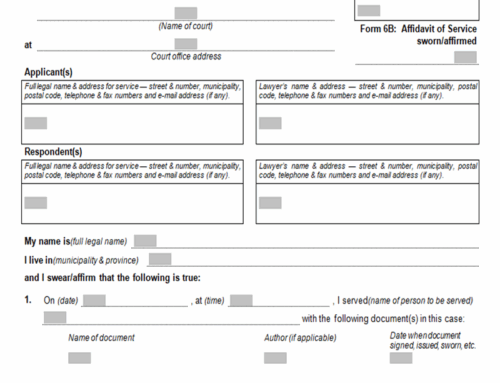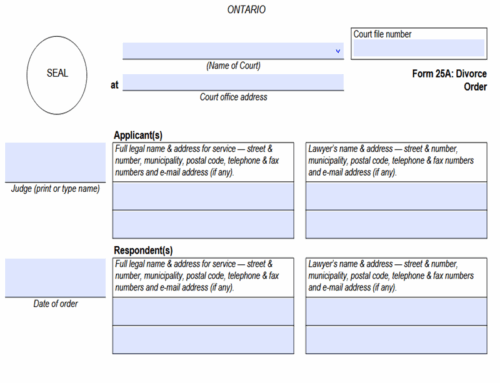

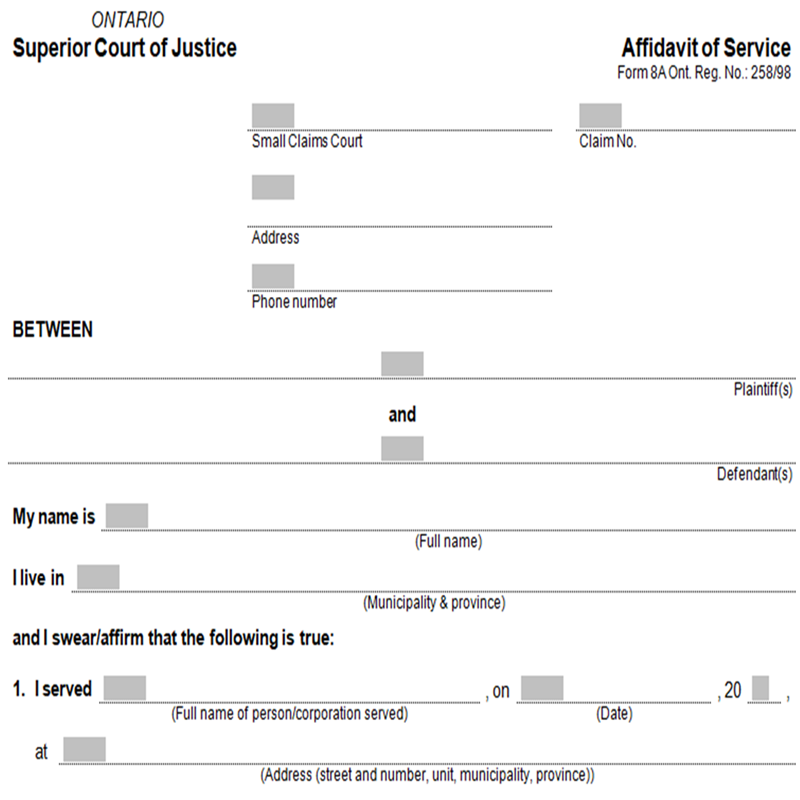
What Is Form 8A – Application (Divorce)?
Form 8A – Application (Divorce) is a court form used in Ontario family law proceedings when a spouse is applying only for a divorce, without asking the court to decide any other family law issues such as child support, spousal support, parenting arrangements, or property division. It is designed to simplify the divorce process when all other matters have already been resolved or are not in dispute.
When Form 8A Is Used Instead of Form 8
Form 8A is used instead of Form 8 – Application (General) when a party is seeking only a divorce order and nothing else.
Form 8 (the general application) must be used when a spouse is asking the court for additional relief, such as:
- Parenting orders or decision-making responsibility
- Child support or spousal support
- Division of property or equalization of net family property
- Exclusive possession of the matrimonial home
- Restraining or non-communication orders
In contrast, Form 8A is appropriate when:
- All other family law issues have already been resolved outside of court
- The parties do not want or need the judge to make any additional orders
- The divorce is uncontested or jointly requested
Courts Where Form 8A Applies in Ontario
Form 8A is used in Ontario family courts that have jurisdiction to grant divorces under the Divorce Act. This includes:
- Superior Court of Justice (Family Court branch)
- Unified Family Court, where available
When filing Form 8A, applicants must ensure:
- The court location has divorce jurisdiction
- At least one spouse has been ordinarily resident in Ontario for at least one year immediately before starting the application
- The application is filed in the correct municipality based on residency rules
Choosing the correct court is essential, as filing in the wrong court can lead to rejected documents and unnecessary delays in the divorce process.
When Should You Use Form 8A?
Joint Divorce Applications
Form 8A is commonly used for joint divorce applications, where both spouses apply together to the court for a divorce.
In a joint divorce:
- Both spouses agree the marriage has broken down
- Neither spouse is making claims against the other
- The ground for divorce is typically one year of separation
- Both parties sign the application
This option is especially suitable when:
- The spouses have already negotiated a separation agreement
- There are no children, or parenting and support issues are fully resolved
- Both parties want a clean and efficient court process
Uncontested Divorces
Form 8A is also appropriate for uncontested divorces, even when only one spouse files the application.
An uncontested divorce means:
- One spouse applies for divorce
- The other spouse does not oppose the divorce
- No claims are made for support, parenting, or property
- The responding spouse either consents or does not file an answer
Situations Where All Divorce-Related Issues Are Already Resolved
Form 8A is most appropriate when all divorce-related matters have already been settled outside of court.
This typically includes situations where:
- A written separation agreement is already in place
- Parenting arrangements have been agreed upon and implemented
- Child support and spousal support obligations are settled
- Property division and equalization have been completed or waived
When Form 8A Is Not Appropriate
Form 8A must not be used if you are asking the court to make decisions on any additional family law issues.
You should not use Form 8A if you are seeking:
- Parenting orders or decision-making responsibility
- Child support or spousal support orders
- Property division or equalization of net family property
- Exclusive possession of the matrimonial home
- Restraining or non-communication orders
- Any temporary or interim relief
In these situations, Form 8 – Application (General) is required instead.
Form 8A is also not appropriate if:
- The divorce is contested
- The other spouse disputes the grounds for divorce
- There are unresolved issues involving children or finances
- You expect the responding spouse to file an answer raising claims
Information Required to Complete Form 8A
Personal Details of Both Spouses
Form 8A requires basic identifying information for both spouses, even if only one spouse is filing the application.
You will need to provide:
- Full legal names of both spouses (as they appear on the marriage certificate)
- Any name changes since marriage, if applicable
- Current mailing addresses
- Contact information (including an address for service)
Marriage Details (Date and Place of Marriage)
Form 8A requires:
- Date of marriage
- City, province/state, and country where the marriage took place
- A valid marriage certificate (or a certified copy)
Separation Date and Grounds for Divorce
Form 8A asks for the grounds for divorce, which establish that the marriage has broken down under Canadian law.
Most applicants rely on:
- One year of separation, which is the most common and straightforward ground
You must include:
- The exact date of separation (day, month, and year)
- Confirmation that the spouses have lived separate and apart for at least one year (or will have done so by the time the divorce is granted)
Children of the Marriage (If Applicable)
If there are children of the marriage, Form 8A requires specific information to ensure their best interests are protected.
You must disclose:
- Names and dates of birth of all children of the marriage
- Whether the children are under the age of majority
- Living arrangements and primary residence
- Whether parenting time or decision-making responsibilities are already in place
Confirmation of Child Support Compliance
When children of the marriage exist, the court must confirm that child support obligations are being met in accordance with the law.
Form 8A requires confirmation that:
- Child support is being paid as required under the Child Support Guidelines, or
- A written agreement or court order addressing child support is already in place
Supporting Documents Required With Form 8A
Marriage Certificate or Certified Copy
A marriage certificate (or a certified true copy) is mandatory when filing Form 8A. The court uses this document to confirm that a legally valid marriage exists and that it has jurisdiction to grant the divorce.
Key points to note:
- The certificate must be issued by the government authority where the marriage was registered
- Church or ceremonial certificates are not accepted
- If the marriage took place outside Ontario or outside Canada, the certificate must still be official and readable
- If the certificate is not in English or French, a certified translation may be required
Separation Agreement (If Applicable)
A separation agreement is not always required, but it is commonly referenced in Form 8A applications where issues such as parenting, support, or property division have already been resolved.
If a separation agreement exists:
- A copy may be attached to show that all related issues are settled
- The court generally does not review or approve the agreement as part of the divorce
- The agreement is used to demonstrate that there are no outstanding claims requiring court intervention
Child Support Documentation
If there are children of the marriage, the court must be satisfied that reasonable child support arrangements are in place before granting a divorce.
Supporting child support documentation may include:
- A separation agreement outlining child support terms
- A prior court order dealing with child support
- A clear statement in the application confirming compliance with the Child Support Guidelines
Additional Affidavits or Schedules
In some situations, additional documents may be required to support the information in Form 8A.
These may include:
- An Affidavit for Divorce (Form 36), which is typically filed later in the process
- An affidavit explaining missing documents, such as an unavailable marriage certificate
- Schedules or attachments related to children, support, or jurisdiction issues
- Proof of service documents if the application is not joint
Filing Form 8A – Application (Divorce) in Ontario
Where to File the Form
Form 8A must be filed with an Ontario court that has jurisdiction to grant divorces under the Divorce Act. This includes:
- The Superior Court of Justice (Family Court branch)
- The Unified Family Court, where available
Divorce applications cannot be filed in Ontario Court of Justice locations that do not have divorce jurisdiction.
The correct filing location is usually based on:
- Where either spouse lives
- Where the spouses last lived together
- A court location that handles family law matters with divorce authority
Before filing, it is important to confirm that the chosen courthouse accepts divorce applications to avoid rejection.
Filing Online vs. Filing in Person
Ontario offers more than one way to file Form 8A, depending on personal preference and court availability.
Filing online
- Available through Ontario’s online family court filing system
- Allows documents to be uploaded electronically
- Filing fees are paid online
- Reduces the need for in-person court visits
- Processing times may vary depending on court workload
Filing in person
- Completed by attending the family court counter at the appropriate courthouse
- Original documents and copies must be brought to the court
- Filing fees are paid at the counter
- Court staff review documents for basic completeness but do not provide legal advice
Court Filing Fees
There is mandatory court filing fees associated with a divorce application in Ontario.
Typical fees include:
- A filing fee when submitting Form 8A
- A second fee payable before the divorce is granted
These fees are set by regulation and are subject to change. Fee waivers may be available for individuals who qualify based on financial hardship, but an application must be submitted and approved by the court.
Failing to pay the required fees will prevent the application from moving forward.
Do You Need a Lawyer to File Form 8A?
You are not legally required to hire a lawyer to file Form 8A – Application (Divorce) in Ontario. Many people complete and file this form on their own, particularly in joint or uncontested divorces. However, whether you should proceed without legal help depends on the complexity of your situation and the potential consequences of mistakes.
Click here to download Form 8A.

Numan Bajwa is the Founding Partner at Bluetown Law – Family Lawyers. He earned his Juris Doctor from the University of Detroit Mercy School of Law (2011–2014) and holds an Honours degree in Criminology from the University of Windsor (2003–2008).