
What Is Form 6B – Affidavit of Service?
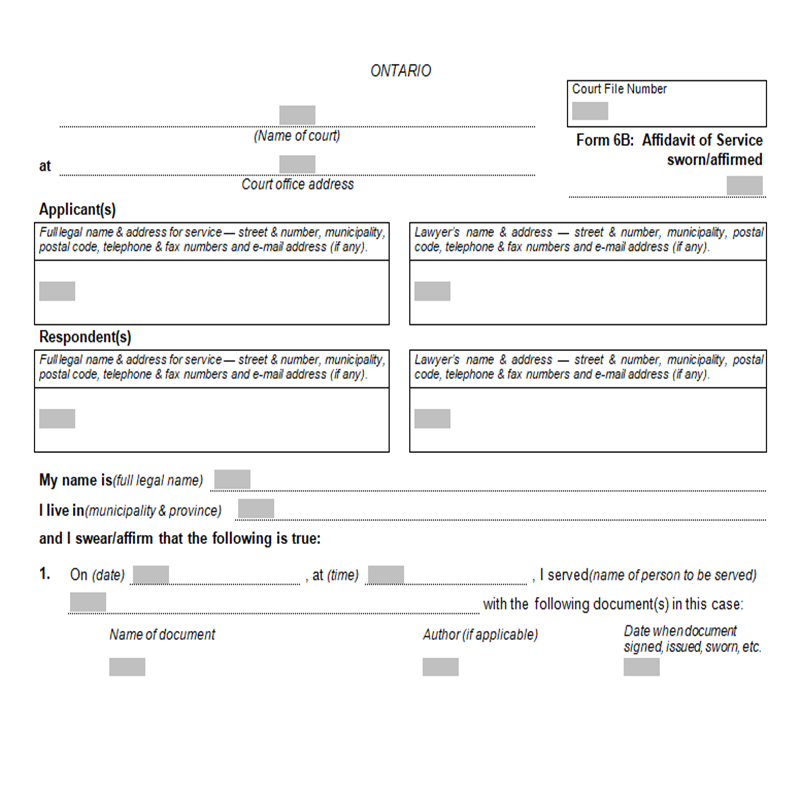
Form 6B – Affidavit of Service is an official Ontario family court document used to confirm that legal documents have been properly delivered (served) to another party in a family law case. It is not the document being served, but rather proof that service has taken place in accordance with Ontario’s Family Law Rules.
Form 6B is required whenever Ontario family law rules mandate proof of service, including but not limited to:
- Applications and responses
- Motions and motion materials
- Financial statements
- Parenting affidavits
- Conference briefs
- Court orders requiring service
How Form 6B Proves Court Documents Were Properly Served
Form 6B proves proper service by documenting compliance with the specific service rules set out in the Family Law Rules, including:
- The method of service used (personal service, regular service, email, courier, etc.)
- The identity of the person served
- The exact date and time of service
- The location or electronic address where service occurred
- The documents included in the service package
Who Can Complete and Sign Form 6B?
Who Can Complete and Sign Form 6B – Affidavit of Service?
Form 6B must be completed and signed by the person who actually served the court documents, not by one of the parties involved in the family law case. Ontario family courts are strict about who may serve documents and who may swear the affidavit, as these rules are designed to ensure fairness, accuracy, and reliability in court proceedings.
Who Is Allowed to Serve Documents in Ontario Family Court?
In Ontario, family court documents may be served by any adult who is at least 18 years old, as long as that person is not a party to the case. This applies to both personal service and regular service, depending on the type of document being served and the method required under the Family Law Rules.
People commonly permitted to serve documents include:
- A friend or family member who is not involved in the case
- A professional process server
- A court runner or courier service (where permitted)
- Any neutral third party who meets the age requirement
Why the Person Serving Documents Cannot Be a Party to the Case
A party to the case, such as an applicant or respondent, cannot serve their own documents in Ontario family court. This restriction exists to avoid conflicts of interest and to ensure the credibility of the service process.
Allowing a party to serve documents on the other party could lead to disputes about:
- Whether service actually occurred
- What documents were served
- When service took place
- Whether the correct person was served
Who Must Swear or Affirm the Affidavit?
Form 6B must be sworn or affirmed by the person who served the documents, not by the lawyer or the party who prepared the court materials.
The affidavit must be sworn or affirmed in front of:
- A commissioner for taking affidavits
- A notary public
- A lawyer authorized to commission affidavits in Ontario
Types of Service Recognised in Ontario Family Court
The Family Law Rules set out when special service, regular service, or alternative service is required, and Form 6B must clearly reflect the method used.
Special Service
Special service usually requires:
- Handing the documents directly to the person being served, or
- Leaving the documents with the person after confirming their identity
Documents that typically require special service include:
- Applications and responses
- Motions to change
- Notices of motion and supporting affidavits
- Orders where the court specifically directs special service
When special service is used, Form 6B must clearly state:
- That special service was completed
- The exact date, time, and location of service
- Confirmation that the documents were personally delivered to the correct individual
Regular Service
Regular service may be completed by:
- Email (where permitted by the rules or court direction)
- Courier
- Fax (in limited circumstances)
- Leaving documents at the person’s residence or place of business, as permitted
Documents often served by regular service include:
- Conference briefs
- Financial statements
- Updated disclosure
- Case conference endorsements
- Other procedural filings
When regular service is used, Form 6B must specify:
- The method of regular service
- The address or electronic destination used
- The date service is deemed effective under the rules
Filing Form 6B with the Court
When Form 6B Must Be Filed
Form 6B must be filed after service is completed and before the court event connected to the documents served. This may include:
- A case conference, settlement conference, or trial management conference
- A motion or motion to change
- A hearing where the court must be satisfied that the other party received notice
As a general rule, Form 6B should be filed as soon as possible after service to avoid delays or procedural objections.
Where to File the Affidavit
Form 6B must be filed with the same court location where the family law case is being heard. This is typically:
- The court where the original application was started, or
- The court that currently has jurisdiction over the matter
Filing Online vs. Filing in Person
Online filing
Many family law documents, including Form 6B, can be filed through Ontario’s online family court filing system. Online filing is commonly used for:
- Uncontested matters
- Ongoing family cases
- Documents served by regular service
When filing online, ensure that:
- The affidavit has already been sworn or affirmed
- The document is properly scanned and legible
- Any required attachments or proof of service are included
In-person filing
In-person filing may be required or preferred when:
- The case involves urgent or complex motions
- The court specifically directs in-person filing
- Technical issues prevent online submission
When filing in person, bring the original sworn Form 6B and any required copies to the court counter.
Deadlines Related to Service and Filing
Deadlines for service and filing depend on:
- The type of document served
- The type of service used (special, regular, or alternative)
- The date of the scheduled court event
In general:
- Documents must be served within the timelines set out in the Family Law Rules
- Form 6B should be filed before the applicable deadline for the document served
- The affidavit must be on the court file before the judge or court clerk reviews the materials
Missing a service or filing deadline can result in:
- Materials being rejected
- A motion or conference being adjourned
- The need to re-serve documents and refile Form 6B
Do You Need a Lawyer to Prepare Form 6B?
You do not need a lawyer to prepare or file Form 6B – Affidavit of Service in Ontario family court. Many self-represented litigants complete and file Form 6B on their own. However, while the form itself may appear straightforward, errors in service or in the affidavit can have serious procedural consequences. For this reason, there are situations where legal assistance is strongly recommended.
Click here to download Form 6B.

Numan Bajwa is the Founding Partner at Bluetown Law – Family Lawyers. He earned his Juris Doctor from the University of Detroit Mercy School of Law (2011–2014) and holds an Honours degree in Criminology from the University of Windsor (2003–2008).