
What Is Form 36 – Affidavit for Divorce?
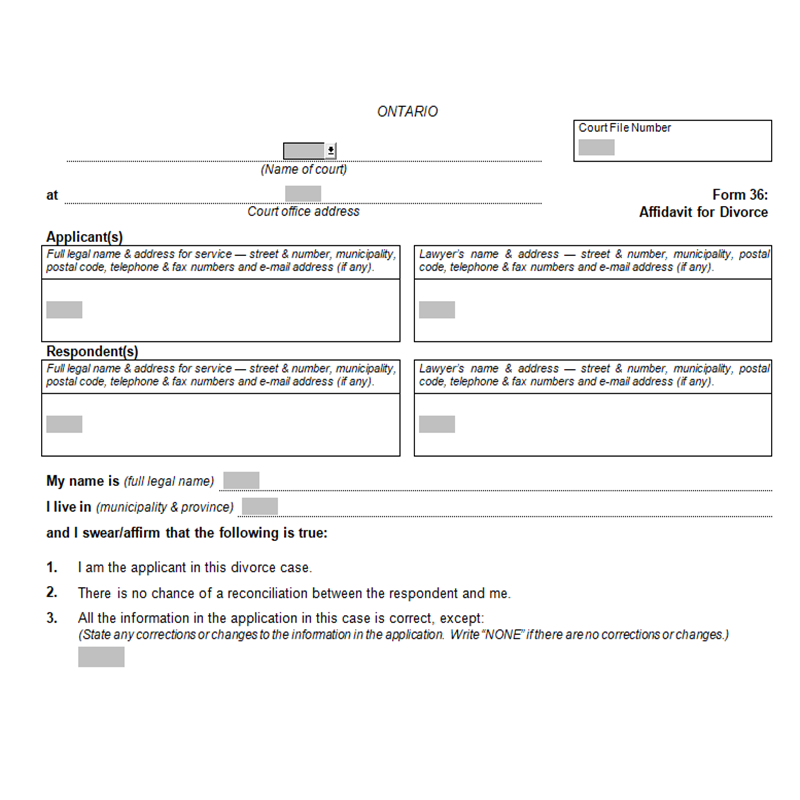
Form 36 – Affidavit for Divorce is a sworn legal document required by Ontario courts before a divorce can be granted. It confirms, under oath or affirmation, that all legal requirements for a divorce have been met and that the information provided to the court is accurate and complete. Unlike an application or motion, Form 36 does not ask the court for relief; instead, it provides the court with verified evidence needed to issue a Divorce Order.
By signing this affidavit, the applicant confirms key facts, including:
- The date of marriage and separation
- That the spouses have lived separate and apart for the required period (usually at least one year)
- That there is no reasonable chance of reconciliation
- That proper arrangements have been made for child support, if applicable
When the Court Requires an Affidavit for Divorce
Ontario courts require Form 36 in most divorce cases, including:
- Uncontested divorces, where one spouse applies and the other does not oppose
- Joint divorces, where both spouses apply together
- Simple divorces, where issues such as property division and support have already been resolved
Without Form 36, the court does not have the sworn evidence it needs to grant the divorce, even if all other paperwork appears to be in order.
Who Must Complete Form 36?
Applicant in a Sole Divorce
In a sole divorce, only one spouse applies for the divorce. In this situation, the applicant spouse is responsible for completing and swearing Form 36.
By signing the affidavit, the applicant confirms to the court that:
- The marriage has broken down under the Divorce Act
- The spouses have lived separate and apart for at least one year (unless relying on adultery or cruelty)
- There is no reasonable chance of reconciliation
- Proper child support arrangements are in place, if children are involved
- The respondent has been properly served or is not opposing the divorce
Both Spouses in a Joint Divorce
By completing Form 36 in a joint divorce, both spouses are confirming that:
- They agree the marriage has irretrievably broken down
- They meet all legal requirements for divorce
- There are no outstanding disputes requiring court involvement
- Child support complies with the Federal Child Support Guidelines, where applicable
Residency and Eligibility Requirements
The affidavit confirms that:
- At least one spouse has lived in Ontario for a minimum of 12 months immediately before filing the divorce application
- The marriage is legally recognized in Canada
- The court has jurisdiction to grant the divorce
Filing Form 36 – Affidavit for Divorce
When to File Form 36 during the Divorce Process
Form 36 is not filed at the beginning of a divorce. It is submitted after key legal requirements have been met, including:
- The divorce application has already been issued by the court
- The mandatory one-year separation period has passed (unless relying on adultery or cruelty)
- The respondent has been served in a sole divorce and any response deadlines have expired
- All child support arrangements comply with the Federal Child Support Guidelines
Where to File the Affidavit
Form 36 must be filed with the Ontario family court that is handling the divorce file. This is usually the same court where the original divorce application was issued.
Depending on the location and type of court, this may be:
- The Superior Court of Justice
- A Unified Family Court location
Filing Online vs. In Person
Ontario allows divorce documents, including Form 36, to be filed online or in person, depending on the circumstances of the case.
Online filing
- Completed through Ontario’s online family court filing system
- Suitable for most uncontested and joint divorces
- Allows documents to be uploaded electronically and tracked
- Reduces processing time and eliminates the need to attend the courthouse
In-person filing
- Done at the family court counter where the divorce was started
- May be required in certain situations, such as when documents cannot be uploaded properly
- Original sworn affidavits must be submitted
Common Filing Errors to Avoid
Mistakes in filing Form 36 can delay the divorce by weeks or even months. Common errors include:
- Filing the affidavit before the one-year separation period has ended
- Forgetting to swear or affirm the affidavit before a commissioner
- Providing dates or details that conflict with the divorce application
- Failing to confirm child support compliance when children are involved
- Filing the affidavit in the wrong court location
- Uploading illegible or incomplete documents when filing online
Supporting Documents Often Filed With Form 36
Marriage Certificate or Proof of Marriage
A marriage certificate or acceptable proof of marriage is required to confirm that the parties were legally married.
- If the marriage took place in Ontario or elsewhere in Canada, a government-issued marriage certificate is typically sufficient
- If the marriage occurred outside Canada, the court may require:
- A foreign marriage certificate
- A certified translation if the document is not in English or French
- Proof that the marriage is legally recognized under Canadian law
Child Support Documentation
When there are children of the marriage, the court places significant importance on child support compliance. Supporting documents often include:
- A copy of the child support agreement or court order
- Financial disclosure showing income used to calculate support
- Confirmation that support follows the Federal Child Support Guidelines
- Proof of ongoing payments, if applicable
Separation Agreement (If Applicable)
If the spouses have signed a separation agreement, it is often filed as a supporting document with Form 36.
The agreement may cover issues such as:
- Child support and parenting arrangements
- Spousal support
- Division of property and debts
Do You Need a Lawyer to Complete Form 36?
Form 36 – Affidavit for Divorce may appear straightforward, especially in uncontested or joint divorces. However, because it is a sworn legal document that directly affects whether a Divorce Order is granted, mistakes can be costly. While a lawyer is not legally required to complete Form 36 in Ontario, there are situations where legal advice is strongly recommended.
Click here to download Form 36.

Numan Bajwa is the Founding Partner at Bluetown Law – Family Lawyers. He earned his Juris Doctor from the University of Detroit Mercy School of Law (2011–2014) and holds an Honours degree in Criminology from the University of Windsor (2003–2008).