
Does a Cohabitation Agreement Become a Marriage Contract in Ontario?
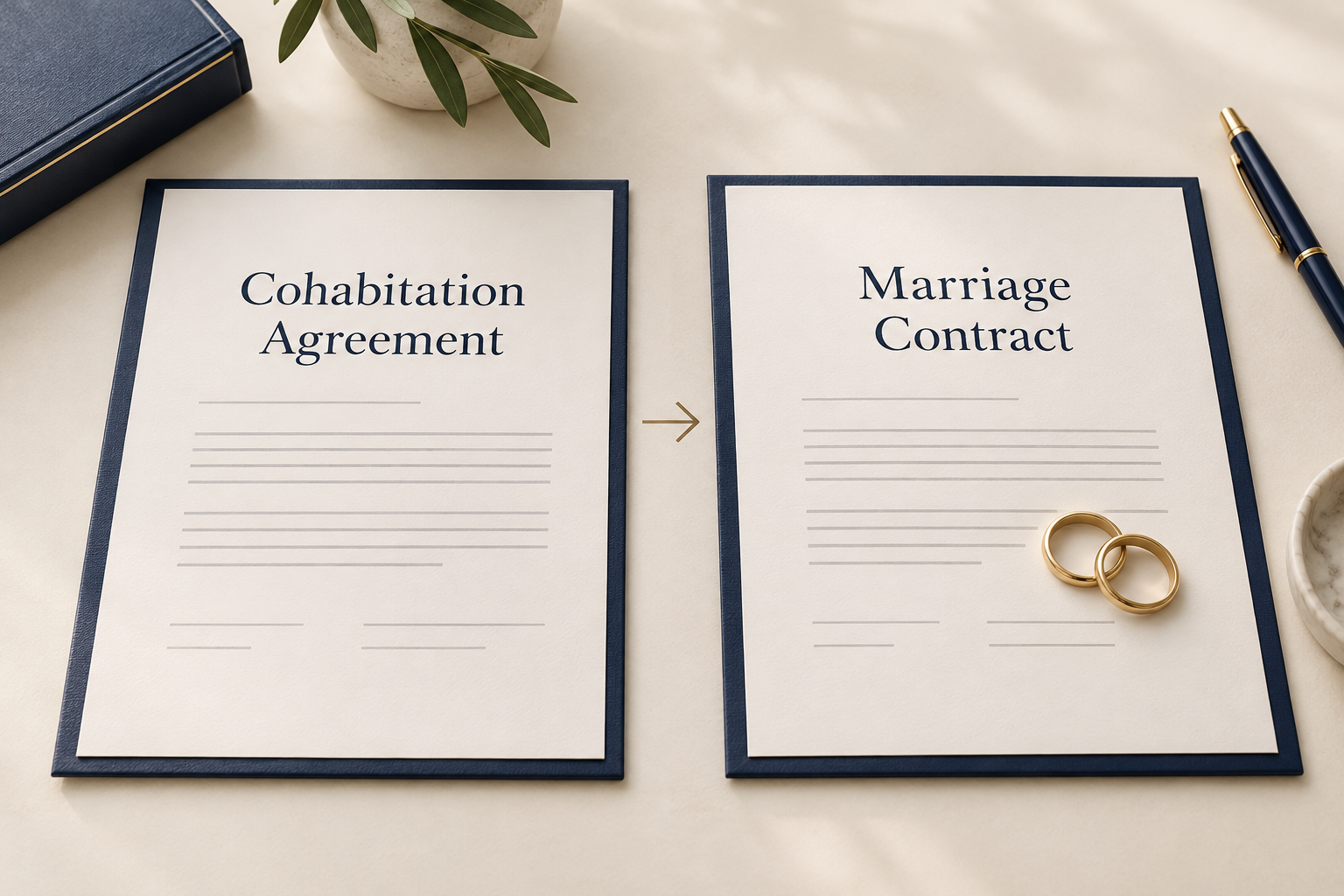
Yes. Section 53(2) of Ontario’s Family Law Act provides that if the parties to a cohabitation agreement later marry each other, the agreement is deemed to be a marriage contract.
A cohabitation agreement is a type of domestic contract used by people who are living together, or intend to live together, but are not married to each other.
It can address matters such as:
- Ownership or division of property
- Support obligations
- Financial arrangements
- Assets and debts
- Other matters concerning the couple’s affairs
Ontario’s Family Law Act specifically permits cohabiting or intending-to-cohabit partners to make these arrangements.
A marriage contract is also a domestic contract. It is mainly entered into by individuals who are already married or wish to marry and need to make certain arrangements.
The critical thing here is that individuals do not need to give up on their earlier cohabitation agreement just because they decide to marry.
If the same two individuals who made the cohabitation agreement later marry each other, then under Ontario law, the agreement automatically becomes a marriage contract.
But this does not mean that all clauses in the contract work in the same way the couple intended when they first made the agreement.
After marriage, there is a different legal status. Some statutory rights may become applicable only after the two parties enter into a marriage.
This is just one of the reasons why a cohabitation agreement may also need to be reviewed prior to marriage.
Does the Agreement Need to Be Signed Again After Marriage?
The existing contract does not require being renewed in order for section 53(2) of the Family Law Act to come into play.
The legal effect is created by the fact that the two get married to each other. Under the law, the cohabitation contract becomes a marriage contract.
This is different from modifying the contract.
The two may feel that certain clauses do not apply anymore to them because they have since gotten married. This could be because of a number of reasons such as buying a house, making investments, having children, running a business, incurring debts among others.
In case they wish to modify or replace the contract, there are legal steps to follow in Ontario.
A domestic contract, including an agreement to amend or rescind one, is unenforceable unless it is:
- In writing
- Signed by the parties
- Witnessed
These requirements are set out in section 55 of Ontario’s Family Law Act.
This does not mean that it cannot be reviewed or contested further. There could be other legal issues involved, too, depending upon the situation.
What remains relevant here then is the extent to which the agreement is able to reflect the realities and intentions of the couple after marriage.
What Happens to the Terms of the Agreement After Marriage?
The mere act of getting married will not automatically negate the terms of the cohabitation agreement.
On the contrary, since the agreement will be considered as a marriage contract, the terms will remain intact concerning issues on property, support, debt, business interests, and other financial matters.
For example, an agreement may contain terms dealing with:
- Property owned before the relationship
- How certain assets will be treated
- Responsibility for particular debts
- Spousal support
- Business interests
- Savings and investments
- Financial responsibilities during the relationship
- Rights or obligations if the relationship ends
Ontario’s Family Law Act expressly allows a cohabitation agreement to address ownership or division of property, support obligations, and other matters concerning the parties’ affairs.
A simple way to understand the change is:
| Before Marriage | After Marriage |
|---|---|
| The parties are unmarried partners | The parties are legally married spouses |
| The document operates as a cohabitation agreement | The document is deemed a marriage contract |
| Rights are considered in the context of an unmarried relationship | Married-spouse rights under Ontario law may become relevant |
| Matrimonial-home rules do not arise simply because the couple cohabits | Matrimonial-home rights may become important after marriage |
Does Marriage Cancel a Cohabitation Agreement?
No. Marriage does not automatically cancel a cohabitation agreement in Ontario.
As per the Family Law Act, once the parties to the cohabitation agreement get married to each other, the said cohabitation agreement is converted into a marriage contract.
This is to say that the couples shall not believe that the said agreement gets dissolved on the day of their marriage.
On the other hand, becoming a marriage contract does not entail that each and every clause overrides all rights that might arise under Ontario family laws.
It is possible that some clauses would continue to stand as they were, whereas others would have to be looked at keeping in view the changed legal position of the couple.
In this way, reviewing the agreement could be of great help for the parties.
Are There Terms That May Work Differently After Marriage?
Yes. Although a cohabitation agreement becomes a marriage agreement if the two parties decide to get married, some provisions have to be thought of in a different manner upon marriage.
This is because marriage gives rise to rights and responsibilities which are not the same for unmarried people.
For example, the couple may need to consider:
- Rights involving the matrimonial home
- Property acquired before or during the marriage
- Spousal support obligations
- Changes in income or financial circumstances
- Business interests that have increased in value
- Whether complete financial disclosure was exchanged
- Whether the original wording still reflects the couple’s intentions
An agreement may also be reviewed or challenged in certain circumstances. The existence of a signed domestic contract does not automatically make every clause enforceable in every situation.
Can a Marriage Contract Change Matrimonial-Home Rights?
There are important limits involving the matrimonial home.
It is mentioned in section 52 (2) of the Family Law Act of Ontario that a clause in a marriage agreement restricting the rights of a spouse in relation to Part II of the Family Law Act regarding the matrimonial home will be nullified.
In simple words, it means that spouses cannot presume that their old cohabitation agreement will terminate all rights in respect to the matrimonial home when they get married.
The property which was considered as one thing when the couple lived together may be dealt with differently as the matrimonial home.
Should You Review a Cohabitation Agreement Before Getting Married?
Sure, a review of the cohabitation agreement prior to marriage can be helpful if there have been changes in their financial situation, property, or family circumstances.
It is not necessarily that the agreement needs to be replaced upon a review.
The idea is to check whether the agreement wording matches the intentions of the couple and if the provisions need clarification.
Consider reviewing the agreement if:
- One partner has acquired significant new assets.
Property ownership may have changed substantially since the original agreement was signed. - A business has increased in value.
The agreement may need to be reviewed to determine how existing business-related provisions would operate after marriage. - Either partner has taken on major debt.
New financial obligations may not have been anticipated when the agreement was prepared. - The couple has purchased a home.
A home used as the family residence after marriage may raise matrimonial-home issues. - One partner already owns the future matrimonial home.
Existing property provisions should be considered alongside Ontario’s statutory matrimonial-home rules. - Income has changed significantly.
Major differences in earnings may affect whether existing support provisions still reflect the couple’s circumstances. - The couple has children.
New family responsibilities may change financial planning and other practical considerations. - Estate-planning goals have changed.
Marriage may affect how the parties want property and financial arrangements to operate on death. - The agreement was signed many years ago.
Older agreements may no longer reflect current assets, debts, property ownership, or intentions. - Either partner no longer understands the agreement.
Both parties should understand what the contract is intended to do after marriage.
Do Both Partners Need Independent Legal Advice?
Independent legal advice can help each partner understand how the agreement affects their own rights and obligations.
A lawyer acting for one partner does not represent the other partner’s interests.
Separate legal advice may help each person understand issues involving:
- Property
- Support
- Financial disclosure
- Business interests
- The matrimonial home
- The consequences of proposed amendments
It can also help identify clauses that may not operate after marriage in the way the parties expect.